sciro.pump
sciro.pump – PUMP devices on the PeakHub, the PUMP counterpart of
pybricks.pupdevices: the generic PUMPDevice plus one class per
device (currently the LP-FloorPro line sensor).
Stub for the frozen module of the same name. Every reading method returns the value directly, or an awaitable under multitasking.
FloorPro
- class sciro.pump.FloorPro(port: Port)
LP-FloorPro connected to a PeakHub port, speaking PUMP.
- dev: PUMPDevice
The underlying generic device.
- serial: str
The device’s 8-character short ID.
- color_sensor(ext_port=1) ColorSensor
The TCS3400 on extension port 1 or 2; raises
OSErrorif none.
- gyro(ext_port=2) Gyro -- the gyro on extension port 1 or 2; raises ``OSError`` if none.
- imu(ext_port=2) Gyro -- alias of :meth:`gyro`.
- all_sensor_data() Tuple -- the same as ``line.read()``.
- dark_centroid() float -- see :meth:`Line.dark_centroid`.
- bright_centroid() float -- see :meth:`Line.bright_centroid`.
- brightness() float -- overall brightness 0 .. 1.
- darkness() float -- overall darkness 0 .. 1.
- line_sensors_binary() Tuple[bool, ...] -- 15 flags, True = bright.
- line_sensors_analog() Tuple[int, ...] -- 15 raw ADC counts
(0 .. 4095), sensor 0 first; one
ir_rawframe on demand.
- streams() Tuple -- the enumerated streams ``(id, url, ext_port, state_len)``.
Streams
- class sciro.pump.Line
IR array derived data (default: every sample, 400 Hz).
- read() Tuple
Returns
(cog_dark, cog_bright, brightness, darkness, mask, calibrating): center of gravity of the dark / bright pixels in sensor pitches from the middle sensor (-7 .. +7), overall brightness / darkness (0 .. 1), a 15-bit bright-pixel mask (bit i = sensor i), and whether calibration is active.
- dark_centroid() float -- center of gravity of the dark pixels, in
sensor pitches from the middle sensor (-7 .. +7).
- bright_centroid() float -- center of gravity of the bright pixels (-7 .. +7).
- brightness() float -- overall brightness 0 .. 1.
- darkness() float -- overall darkness 0 .. 1.
- line_sensors_binary() Tuple[bool, ...] -- 15 flags, sensor 0 first,
True where the sensor sees bright.
- calibrating() bool -- True while the min-max calibration runs.
- calibrate(enable: bool = True) MaybeAwaitable
calibrate(enable=True) – start/stop min-max calibration of the array.
- state() bytes | None -- the stream's current state prefix.
- subscribe(mode: int, rate: int = 0) MaybeAwaitable
subscribe(mode, rate=0) – rate in Hz, 0 = every sample; see
PUMPDevice.subscribe().
- dev: PUMPDevice
- id: int
- class sciro.pump.IRRaw
15 raw 12-bit ADC readings. Off by default: use
oneshot()or subscribe.- read() Tuple[int, ...] -- 15 values, 0 .. 4095, sensor 0 first.
- oneshot() Tuple[int, ...] -- request one frame and return it.
- state() bytes | None -- the stream's current state prefix.
- subscribe(mode: int, rate: int = 0) MaybeAwaitable
subscribe(mode, rate=0) – rate in Hz, 0 = every sample; see
PUMPDevice.subscribe().
- dev: PUMPDevice
- id: int
- class sciro.pump.IRCalib
Calibration table of the IR array. Off by default.
- read() Tuple
Returns
(min, max, min_visited_mask, max_visited_mask)withminandmaxtuples of 15 raw counts.
- oneshot() Tuple -- request the table once and return it.
- state() bytes | None -- the stream's current state prefix.
- subscribe(mode: int, rate: int = 0) MaybeAwaitable
subscribe(mode, rate=0) – rate in Hz, 0 = every sample; see
PUMPDevice.subscribe().
- dev: PUMPDevice
- id: int
- class sciro.pump.Pixels
The sensor’s own LED strip picture, rendered on the device at full scale: 18
(r, g, b)triplets = IR channels 0..14, EXT1, EXT2, battery. Off by default. A PeakHub mirrors it on its 5x5 matrix withsciro.hubs.LightMatrix.device().- read() Tuple[Tuple[int, int, int], ...] -- 18 RGB triplets, 0 .. 255.
- oneshot() Tuple -- request one frame and return it.
- state() bytes | None -- the stream's current state prefix.
- subscribe(mode: int, rate: int = 0) MaybeAwaitable
subscribe(mode, rate=0) – rate in Hz, 0 = every sample; see
PUMPDevice.subscribe().
- dev: PUMPDevice
- id: int
Extension-port devices
- class sciro.pump.ColorSensor(port: Port | PUMPDevice, ext_port: int = 1)
TCS3400 color sensor on an extension port of a PUMP device.
ColorSensor(port, ext_port)opens it directly;FloorPro.color_sensor()returns the same class.hsv()andcolor()followpybricks.pupdevices.ColorSensor.Every sample is tagged with the settings it was measured under, so a read after a settings change waits for the first sample taken with the new settings.
- ext_port: int
- read() Tuple[int, int, int, int, int] -- raw (red, green, blue, clear, status) at device resolution.
- calibrated() Tuple[int, int, int]
Red, green, blue 0 .. 255 as the device itself shows them: stretched over the calibrated range when a valid calibration applies, scaled to full scale otherwise.
- hsv() Color
Hue (0 .. 359), saturation (0 .. 100) and value (0 .. 100) of the surface, as a
Color: standard HSV of the calibrated color when a valid calibration applies, of the raw reading otherwise.
- calibration_status() str
"none"(nothing stored),"weak"(stored but not applicable: incomplete, or LED / gain / integration differ from the calibration profile),"ok"(applied), or"calibrating".
- calibrate(enable=True)
Start or stop the range calibration on the device. While it runs, move the sensor over the darkest and brightest surfaces (or elements) it will see; stopping stores the table on the sensor, bound to the LED, gain and integration time in force. Changing those meanwhile aborts it.
- clear_calibration() MaybeAwaitable
clear_calibration() – drop the stored calibration (back to full-scale color).
- calibration() Tuple
The stored table:
(min, max, (led, gain, atime), valid, applicable, visited_mask)withmin/maxtuples of four counts (red, green, blue, clear). Fetched from the device on demand.
- color() Color
The nearest of the detectable colors (default: red, yellow, green, blue, white, none), matched like
pybricks.pupdevices.ColorSensor.
- detectable_colors(colors: Iterable[Color] | None = None) Tuple[Color, ...] | None
detectable_colors(colors) – set the colors color() chooses from; with no argument, get them.
- settings() Tuple[int, int, int] -- (led_percent, gain_x, atime) in effect.
- set_light(percent: int) MaybeAwaitable
set_light(percent) – illumination LED duty, 0 .. 100.
- set_gain(gain_x: int) MaybeAwaitable
set_gain(gain_x) – analog gain: 1, 4, 16 or 64.
- set_integration(atime: int) MaybeAwaitable
set_integration(atime) – TCS3400 ATIME register 0 .. 255: (256 - atime) * 2.78 ms.
- state() bytes | None -- the stream's current state prefix.
- subscribe(mode: int, rate: int = 0) MaybeAwaitable
subscribe(mode, rate=0) – rate in Hz, 0 = every sample; see
PUMPDevice.subscribe().
- dev: PUMPDevice
- id: int
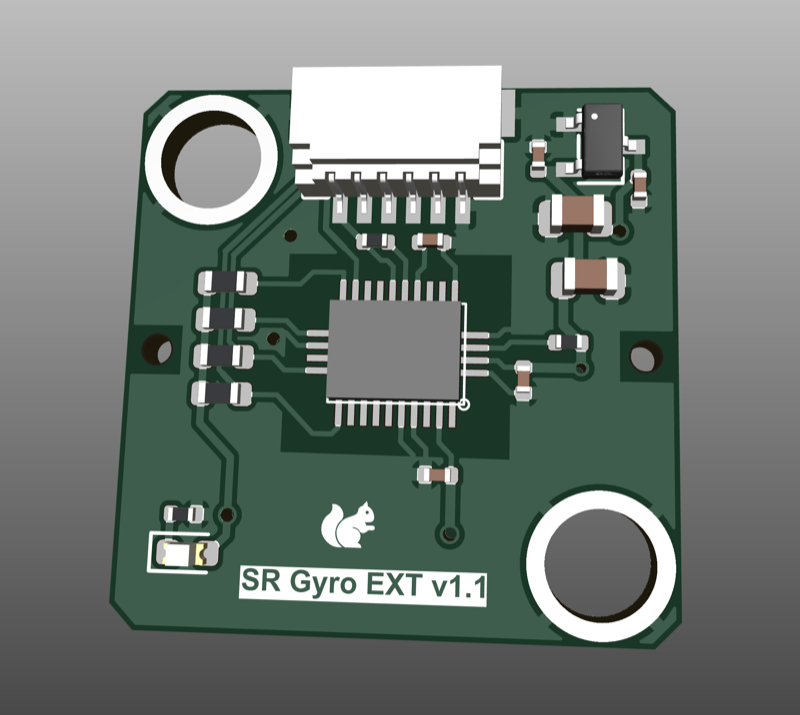
The Gyro (BNO086) on its extension board.
- class sciro.pump.Gyro(port: Port | PUMPDevice, ext_port: int = 2)
Gyro (BNO086) on an extension port of a PUMP device: roll, pitch, yaw in degrees.
Gyro(port, ext_port)opens it directly;FloorPro.gyro()returns the same class (IMUis an alias). The heading offset lives on the hub:reset_heading()makes the current yaw read as the given angle.- ext_port: int
- read() Tuple -- (roll, pitch, yaw, status), degrees; yaw includes the offset.
- heading() float -- yaw in degrees (-180 .. 180], with the offset applied.
- reset_heading(angle: float = 0) MaybeAwaitable
reset_heading(angle=0) – make the current heading read as
angle.
- state() bytes | None -- the stream's current state prefix.
- subscribe(mode: int, rate: int = 0) MaybeAwaitable
subscribe(mode, rate=0) – rate in Hz, 0 = every sample; see
PUMPDevice.subscribe().
- dev: PUMPDevice
- id: int